Can AI answer engines actually read, and cite, your site?
Key takeaways
- Four things must all work before an AI engine can cite you: edge access, index presence, passage retrieval, and attribution. Any one failing looks identical from the outside.
- The most common cause of zero AI visibility is infrastructure, not content: a firewall refusing crawlers your robots.txt welcomes.
- No major AI crawler executes JavaScript, so client-rendered content is invisible to every engine except Google.
- AnswerOpen scores every page 0-100 across 61 deterministic checks, then applies the fixes with backups and your approval.
- Audits are $299 one-time; monitoring starts at $79 a month with all engines included.
AnswerOpen audits a website the way ChatGPT, Perplexity, Google's AI results and Copilot actually read it: raw HTML fetched by nine real AI crawler user-agents, roughly 61 deterministic checks on every page, one 0–100 score per page — and then the fixes get applied to your site, not filed in a slide deck.
Request an audit See how it works
What is answer engine optimization, in one paragraph?
Answer engine optimization (AEO) is making a page retrievable, extractable and quotable by the language models that now answer questions instead of listing links. It is a different problem from ranking. An answer engine has to (1) be allowed through your edge, (2) find the page in an underlying search index, (3) parse an answer out of raw HTML with no JavaScript executed, and (4) resolve who published it well enough to name you. Any one of those four failing produces the same symptom: you are never mentioned, and nothing in your analytics tells you why.
Why is this different from an AI visibility tracker?
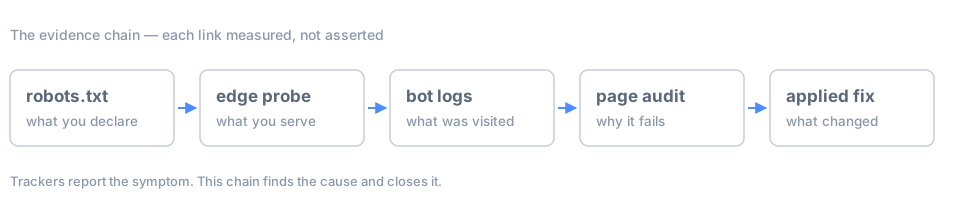
Trackers sample prompts and tell you your share of voice. That is a symptom report. AnswerOpen is built around a causal chain, and each link is measured rather than asserted:
The door check almost nobody runs
We fetch your pages as GPTBot, OAI-SearchBot, ChatGPT-User, ClaudeBot, Claude-User, PerplexityBot, Perplexity-User, Bingbot and Googlebot, and compare each response against a browser baseline — status, challenge markers, and body word-count parity. "robots.txt allows it but the WAF 403s it" is the signature 2025–26 failure mode, and a robots.txt linter cannot see it.
Every page, scored and explained
Not one site-wide verdict. Each URL gets its own 0–100 across five weighted categories, with the exact check that failed, the reason it matters, and the specific edit that clears it. Our own audit of a 679-page site produced a ranked fix plan naming every affected URL.
Fixes applied, not recommended
Entity blocks, publisher data, schema consistency, heading anchors and dates are drafted as diffs, staged with a full backup, and written to your origin only on your approval. Monitoring products stop at the recommendation.
How is the score weighted?
Category weights come from a research pass over 2025–2026 measured studies and official operator documentation, not from intuition. The two categories that decide whether an engine can even use your page carry more than half the score, and schema is deliberately held down because the best available evidence does not show it lifting citations.
| Category | Weight | Why it carries that weight |
|---|---|---|
| AI crawler access | 30 | The silent killer. Cloudflare has default-blocked AI crawlers on new zones since July 2025. Policy and edge behavior are cross-joined. |
| Answer structure | 26 | 44.2% of ChatGPT citations come from the first 30% of a page's content; question-form content is cited about twice as often. |
| Extractability | 24 | No major AI crawler executes JavaScript, and snippet directives officially gate Google's AI surfaces. |
| Entity clarity | 12 | An engine must resolve who is behind the page to name the brand — but the biggest entity levers live off-site. |
| Answer schema | 8 | A matched diff-in-diff on 1,885 pages found no citation lift from adding JSON-LD, so our schema checks police contradiction, not presence. |
See the full check catalog and the evidence tier behind each one.
What results can you actually show?
We are a new product with two audited production sites, both our own. We are not going to invent customer logos. Here is the entire measured record, taken straight from consecutive engine runs on 14 August 2026:
| Site | Pages crawled | AEO before | AEO after | Classic SEO |
|---|---|---|---|---|
| claritytaxrelief.com | 682 | 91.7 | 98.4 | 99.5 |
| bnbokc.com | 391 | 87.9 | 93.5 | 98.9 |
Both sites are operated by the same owner as AnswerOpen. Treated as engineering evidence that the tool runs at scale and that applied fixes move the score — not as a customer testimonial, because they are not customers.
If our fetcher cannot see it, neither can ChatGPT. That is why static analysis is architecturally sufficient here rather than a compromise — and why a ten-thousand-page crawl stays cheap.
— AnswerOpen engine design note, check catalog 2026-08
What this does not do
- It does not promise citations. On-site factors are the controllable minority of citation variance; branded web mentions correlate roughly 0.66–0.71 with AI visibility against about 0.22 for backlinks, and roughly 82% of citations are earned media. We report the off-site work as an action plan and score only what your site controls.
- It does not render JavaScript, on purpose — see why that is the correct choice.
- It does not sample every engine yet. Prompt-level visibility sampling runs today through one model provider plus web search and is labelled as API-sampled wherever it appears.
- It is not a self-serve product yet. Audits are run and reviewed by a human. Read the pricing page for exactly what exists today.
Primary sources
Everything asserted above traces to one of these. Operator documentation changes often; check the current version before relying on any of it.
- OpenAI crawler documentation — the authoritative list of GPTBot, OAI-SearchBot and ChatGPT-User behavior
- Google robots meta tag reference — how nosnippet, max-snippet and noindex gate AI surfaces
- Generative Engine Optimization (KDD 2024) — the only peer-reviewed causal evidence on content modifications and generative visibility
- Bing Webmaster Tools — first-party AI performance data, and the free ground truth for any prediction we make
Request an audit of your site
There is no fake "instant scan" button on this site. A real audit crawls your sitemap, fetches every page, and runs nine live user-agent probes against your edge — it takes minutes of machine time, not milliseconds, and it is run by a human who reads the result before you see it. Send the URL and you get the headline score plus your single largest blocker back, at no charge.
Frequently asked questions
What is answer engine optimization?
Answer engine optimization is making your pages retrievable, extractable and quotable by AI systems that answer questions directly instead of listing links. It covers four things: whether your edge lets AI crawlers in, whether the underlying search index has your page, whether your page is retrieved for the sub-question the engine actually asked, and whether the model can tell who published it.
How is this different from an AI visibility tracker?
Trackers sample prompts and report your share of voice, which tells you the symptom. This tool measures the causal chain underneath: what your robots.txt declares, what your edge actually serves nine real AI crawler user-agents, what your server logs prove was visited, why each page passes or fails 61 checks, and then applies the fixes.
Do I need to install anything on my site?
No. The audit is an external read-only crawl. There is no plugin, no tag, no CMS access and no analytics connection required, which is also why it can audit a competitor's site or a prospect's site before you have any relationship with them.
Can you guarantee my site gets cited by ChatGPT?
No, and neither can anyone else. Branded web mentions correlate roughly three times as strongly with AI visibility as backlinks do, and around 82% of citations are earned media, none of which is on your website. We score what your site controls and report the rest as an action plan.
How long does an audit take?
A 679-page production site completed in about ten minutes of crawl time and roughly five thousand HTTP requests. Turnaround including human review is two to three business days for a full audit, and one business day for a free sample check.
Is the score reproducible?
Yes. Every check is a deterministic function of the raw HTML and response headers, with no model calls and no headless rendering at audit time. Run it twice on an unchanged site and the numbers are identical, so a before-and-after comparison is a real measurement.